Showing posts with label shell. Show all posts

How do Some Creatures Make a Shell on their Body?

            You must have heard the sound of conch (shank) being blown during worship in the temples. You must have also seen big and small conches on the seashores and on the riverbanks. Some conches are so small that they can be seeing only with the help of a magnifying lens. While there are others that are as big as measuring up to 120 cm.

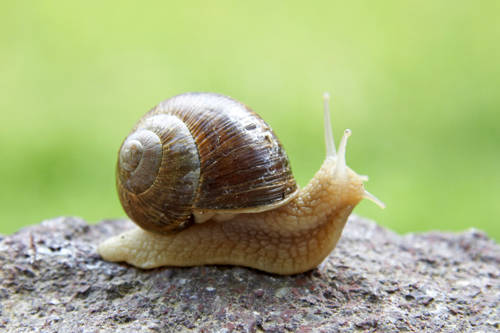
Snail

            Do you know what these conches are and how they are formed? They are the body shells of aquatic creatures. These creatures are called mollusks. The scientists have so far studied approximately 60,000 species of the mollusks. As the mollusk grows; the outer shell also grows and becomes harder. They are made up of calcium carbonate lime. The mollusk collects lime form seawater and deposits it in its outer shell. When the mollusk dies, the shell floats and comes to the surface of water.

            The shell of the mollusk has three main layers. The outer layer of the shell is made up of smooth material like the oyster and contains absolutely no lime. The middle layer is made up of calcium carbonate. The inner layer comprises man thin layers, which are made up of oyster-like material and calcium carbonate. Conches come in many colors. Some of them have pattern of stains and stripes on them. These stains, colors and stripes have their origin in some colorful materials present in the glands of the mollusk, and these colors, stripes and stains enhance the beauty of the conches.

            The conches protect the mollusk living inside. When the mollusks finally die, the shells become very useful to us in many ways. In early times, people used mollusk shells (cowries) as coins.

            Small conches are even used in necklaces, and as decoration pieces in homes. Mother-of-pearl buttons are made from small shells. Aquatic animals with shells have existed for billions of years. After their death, these shells are deposited on the seabed, which form limestone rocks.

How are Pearls Formed?

            Right from the earliest times pearls have fascinated people because of their luster and beauty. Real pearls are very precious because they are rare.

            The formation of pearls is very interesting. Oyster a small sea creature produces pearls by coating grit with nacre a pearly layer that lines the insides of its shell.

Pearls in many colors

            When a sand particle gets inside the shell of an oyster it rubs against the animals tender body. To soothe this irritation the oyster starts depositing layer upon layer of the pearly nacre on this particle. These layers of nacre are made up of calcium carbonate which result in the formation of the pearl inside the shell. The pearl so formed is round white and shining. The is the real pearl. However the peals are not necessarily white only. Their colors may be black white pink pale blue, yellow, green, or mauve.

A Pearl in the Oyster shell

            Approximately four thousand years ago a hungry Chinese began to open some oysters to eat on the seashore. Inside one of the oysters he found a small round shiny ball. The shining ball-like object came to be known as a pearl.

            Man has now developed techniques of making artificial pearls. Using these techniques sand particle is injected into the shell of an oyster and it is then kept back in the water. After a couple of years the shell is taken out and the pearl is extracted from it. These pearls are called cultures peals. Japan has perfected the technique of making beautiful cultured pearls. Since pure natural pearls are very costly most people buy cultured pearls. On May 7, 1934 a pearls was found in Philippines with a diameter of 13 centimeters. This pearl weighing about 6.37 kilograms is called the pearl of Laoxi.

EVERGREEN POSTS